

Canadian small businesses are rapidly moving away from traditional phone systems and asking, “is VoIP the future of small business communication?” The answer is clear. Why VoIP Is the Future of Small Business Communication lies in its cost efficiency, scalability, flexibility, and seamless integration with modern business tools.
Startups and SMEs across Canada benefit from reliable, remote-friendly connectivity while improving productivity and customer engagement. VoIP delivers unified communication solutions that outperform legacy telecom systems, making it the smartest choice for forward-thinking businesses nationwide.
The Evolution of Business Communication
Business communication has evolved significantly over the past few decades. It began with copper landlines, progressed to PBX hardware systems, and has now transitioned to modern VoIP technology. While each stage focused on connectivity, only VoIP offers the flexibility, scalability, and integration capabilities required by today’s hybrid workforce.
This evolution explains why legacy systems are becoming outdated in the future of VoIP for small businesses.
Landlines and Early Telecom Systems
Traditional copper landlines were reliable but limited. They required expensive infrastructure, high maintenance, and offered minimal flexibility. Long-distance charges and fixed-line costs made small business communication rigid and costly.
These systems do not support hybrid teams, mobile workers, or multi-location offices. For Canadian businesses seeking modern business phone services, legacy systems have become restrictive compared to today’s cloud-based VoIP solutions.
The Rise of PBX Systems
PBX systems centralized business calls and offered improved internal communication. However, they depended heavily on on-site hardware and required regular maintenance. Scaling required expensive hardware upgrades, and downtime often meant waiting for in-person technical support.
While PBX improved control compared to landlines, it lacks the agility modern businesses demand. The future of VoIP for small businesses surpasses PBX systems by offering cloud flexibility and remote accessibility.
Cloud Computing and Hosted Systems
Cloud computing introduced hosted VoIP, reducing reliance on physical hardware and enabling remote connectivity. Businesses could now manage calls via the internet, integrate with productivity tools, and scale operations easily.
Hosted systems demonstrated clearly why many ask, “is VoIP the future of small business communication?” Canadian businesses can now leverage local, cloud-based VoIP phone service without costly infrastructure.
Modern VoIP Technology
Modern VoIP transmits voice over the internet and integrates with unified communications platforms. Businesses gain access to features such as:
- Video conferencing
- Mobile and desktop apps
- Auto-attendants
- CRM integration
- Unified messaging
Scalable systems support multi-location operations and remote workforce collaboration. The future of business communication technology lies in these unified and flexible VoIP solutions, delivering cost savings and operational efficiency to Canadian SMEs.
Why Traditional Phone Systems Are Becoming Obsolete
Legacy telecom systems struggle with high long-distance costs, limited hybrid workforce support, poor CRM integration, and infrastructure vulnerabilities.
In contrast, VoIP for small business offers agility, lower communication costs, and advanced features. By adopting cloud-based VoIP, Canadian businesses gain flexibility, remote access, and improved operational efficiency.
- Cost Efficiency and Predictable Pricing
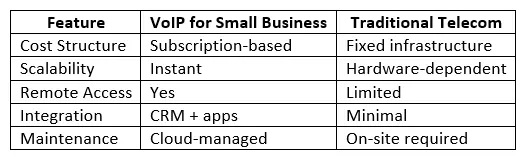
VoIP operates on subscription-based pricing with no major hardware investments. Businesses can scale user accounts easily without expensive infrastructure upgrades.
Lower long-distance and international rates make VoIP a cost-effective solution for Canadian SMEs exploring the future of VoIP for small businesses.
- Flexibility for Remote and Hybrid Teams
VoIP supports remote work through mobile apps, softphones, and cloud dashboards. Teams can communicate from anywhere in Canada, ensuring business continuity.
With hybrid work becoming the norm, many businesses confirm that is VoIP the future of small business communication is no longer a question—it is reality.
- Scalability Without Infrastructure Limits
VoIP allows businesses to add or remove users instantly. Unlike traditional PBX systems, there are no physical limitations or expensive hardware extensions.
This makes the future of VoIP for small businesses practical, especially during seasonal growth, expansion, or high-demand periods.
- Advanced VoIP Features for Small Business
Modern VoIP systems offer enterprise-level tools such as:
- Auto-attendants
- Intelligent call routing
- Video conferencing
- Call analytics
- Unified messaging
These features help Canadian SMEs improve productivity, streamline customer service, and reduce operational costs.
- Integration With Modern Business Tools
VoIP integrates with CRM systems like Salesforce and HubSpot, as well as collaboration platforms such as Microsoft Teams and Zoom.
These integrations automate workflows, enhance customer tracking, and improve engagement. Even entry-level solutions like Google Voice demonstrate that VoIP fits seamlessly into today’s digital ecosystem.
Technology Trends Shaping the Future of VoIP
In Canada, VoIP innovation is driven by AI, Unified Communications as a Service (UCaaS), SIP trunking, and 5G connectivity. These advancements continue shaping the future of business communication technology.
AI and Automation
AI enhances call routing, transcription, sentiment analysis, and predictive insights. VoIP systems can prioritize high-value calls and improve customer satisfaction.
AI-powered communication tools reinforce why Why VoIP Is the Future of Small Business Communication is becoming a widely accepted reality.
Unified Communications Platforms
UCaaS combines voice, messaging, and video into one dashboard. Businesses using VoIP-integrated platforms experience improved collaboration, reduced costs, and streamlined workflows.
SIP Trunking and Infrastructure Modernization
SIP trunking replaces traditional PRI lines, reducing dependency on physical infrastructure while improving call quality and reliability.
Canadian businesses adopting SIP trunking experience greater flexibility and cost savings.
5G and High-Speed Internet in Canada
Canada’s expanding fibre and 5G networks support HD voice calls and low-latency connectivity. Improved infrastructure strengthens the future of VoIP for small businesses, ensuring consistent and reliable communication nationwide.
Benefits of VoIP Specifically for Canadian Small Businesses
VoIP offers significant advantages for Canadian SMEs:
- Reduced telecom costs
- Easy expansion across provinces
- Local and toll-free number flexibility
- Support for bilingual customer service
- Improved hybrid workforce collaboration
By adopting VoIP, businesses gain a competitive edge while future-proofing their communication infrastructure.
VoIP vs Traditional Telecom – Side-by-Side Comparison
Security and Reliability Considerations
VoIP systems use encryption, multi-factor authentication, and data redundancy to protect business communications. Hosting data within Canada ensures compliance with local regulations.
With 99.9% uptime guarantees and secure infrastructure, businesses can confidently rely on VoIP for dependable communication.
Future Predictions – Business Communication in 2026 and Beyond
By 2026, AI-driven automation will transform business communication. Voice, messaging, and video will merge into intelligent unified platforms.
Businesses will leverage predictive analytics, personalized responses, and workflow automation to optimize customer interactions. Cloud-based systems will dominate, making VoIP indispensable in the future of business communication technology.
Frequently Asked Questions
What is VoIP and how can small businesses use it?
VoIP transmits voice over the internet, allowing businesses to make calls, route customers, and integrate with productivity apps efficiently.
Is VoIP reliable for Canadian businesses?
Yes. With high-speed internet, cloud redundancy, and service-level guarantees, VoIP is secure and dependable.
How much does VoIP cost compared to traditional service?
VoIP typically costs significantly less due to subscription pricing and reduced hardware expenses.
Can VoIP support remote teams?
Absolutely. Mobile apps and cloud dashboards allow teams to collaborate from anywhere in Canada.
Is VoIP secure?
Yes. Modern VoIP systems use encryption, MFA, and Canadian data hosting to ensure privacy and compliance.
Conclusion – The Future Is Already Here
Traditional telecom is declining, and cloud phone system adoption is accelerating across Canada. VoIP for small business delivers flexibility, innovation, and AI-driven communication that reshapes customer interactions. Unified platforms provide seamless integration and predictive analytics for smarter, more efficient operations.
Modern companies clearly understand why VoIP is the future of small business communication. Explore VoIP phone service and business phone service Port Coquitlam to upgrade your connectivity. Choose Eazy Connect for low-cost, reliable VoIP for small businesses and homes, and improve your communication efficiency today.
Ready to upgrade your communication system? Contact eazyconnect today to reduce costs, boost productivity, and scale your business confidently across Canada with reliable VoIP solutions.
