

If you run a small business in Canada, you have likely asked yourself: Is VoIP secure for small business operations? It is a fair question. Between ransomware incidents and targeted data breaches, cybersecurity is no longer just an IT concern, it is a boardroom priority. Many owners are concerned about call interception or the exposure of confidential customer data, especially as remote teams rely more on the cloud. The good news is that modern VoIP systems utilize enterprise-grade encryption, secure signalling and layered protection that often exceed the capabilities of traditional landlines. In this guide, we analyze real-world risks, the security of VoIP for business use, Canadian compliance standards and the key factors in selecting a local provider that prioritizes your security.
What Is VoIP Security?
VoIP security is the framework of technologies and safeguards that protect voice data from interception, tampering or unauthorized access as it is transmitted over IP networks. This includes advanced encryption protocols such as SRTP and SIP over TLS, alongside robust firewall configurations and 24/7 network monitoring. Essentially, these security layers ensure your business calls and recordings stay private and protected from the moment you dial until the call ends, clearly demonstrating how secure is VoIP when properly implemented.
How VoIP Works
VoIP converts voice into digital packets. These packets are transmitted across your internet connection or secure cloud infrastructure and reassembled into audio at the destination. Unlike traditional PBX systems that relied on physical copper lines, modern VoIP operates within cloud communications environments, often hosted in secure Canadian data centres. This model supports encryption, centralized updates and real-time threat monitoring.
Common VoIP Security Risks
Understanding the risks is the first step in determining the answer: is VoIP secure for small business? Here are the most relevant concerns for the Canadian SMB landscape.
End-to-End Encryption
Unencrypted voice traffic can be vulnerable, especially on unsecured public Wi-Fi. Encrypted VoIP calls using SRTP prevent readable interception by scrambling the data packets.
SIP-Based Attacks
SIP manages your call setup. Without proper configuration, your system could be exposed to:
- Registration hijacking
- Toll fraud
- Unauthorized call routing
Secure SIP configuration and robust authentication significantly reduce these risks.
DDoS Attacks on VoIP Systems
A Distributed Denial of Service attack overwhelms a system with traffic, causing outages. For a small business, downtime can mean missed opportunities and lost revenue.
Phishing & Vishing Attacks
Voice-based scams, known as vishing, use caller ID spoofing and social engineering to trick employees into sharing credentials or sensitive data. Employee awareness is critical.
Weak Passwords and Poor Authentication
Weak admin credentials remain one of the most common entry points for attackers. Implementing Multi-Factor Authentication (MFA) dramatically reduces the risk of account takeovers.
Unsecured Wi-Fi & Remote Work Risks
Hybrid work is now the standard across Canada. However, employees connecting through home networks can introduce security gaps. A properly configured VPN for remote staff strengthens your overall security posture.
How Modern VoIP Systems Stay Secure
When deployed correctly, VoIP can be highly secure. Protection relies on multiple layers.
End-to-End Encryption
Secure Real-Time Transport Protocol (SRTP) encrypts voice packets during transmission. Even if someone captures the transmission, the information remains unreadable.
Secure SIP with TLS
Transport Layer Security (TLS) protects SIP signalling, preventing tampering and spoofing during call setup.
Firewall and Network Controls
A business-grade firewall with VoIP-specific rules manages incoming and outgoing traffic. Many Canadian enterprises also deploy intrusion detection systems for real-time threat visibility.
Multi-Factor Authentication (MFA)
MFA adds a vital verification step to logins, significantly reducing the risk of unauthorized access to administrative portals and system settings.
Network Monitoring & Threat Detection
Reputable local providers maintain 24/7 network monitoring. They use anomaly detection to identify and address potential threats proactively. Often, they resolve issues before the end-user is even aware of them.
VoIP vs Traditional Landline Security
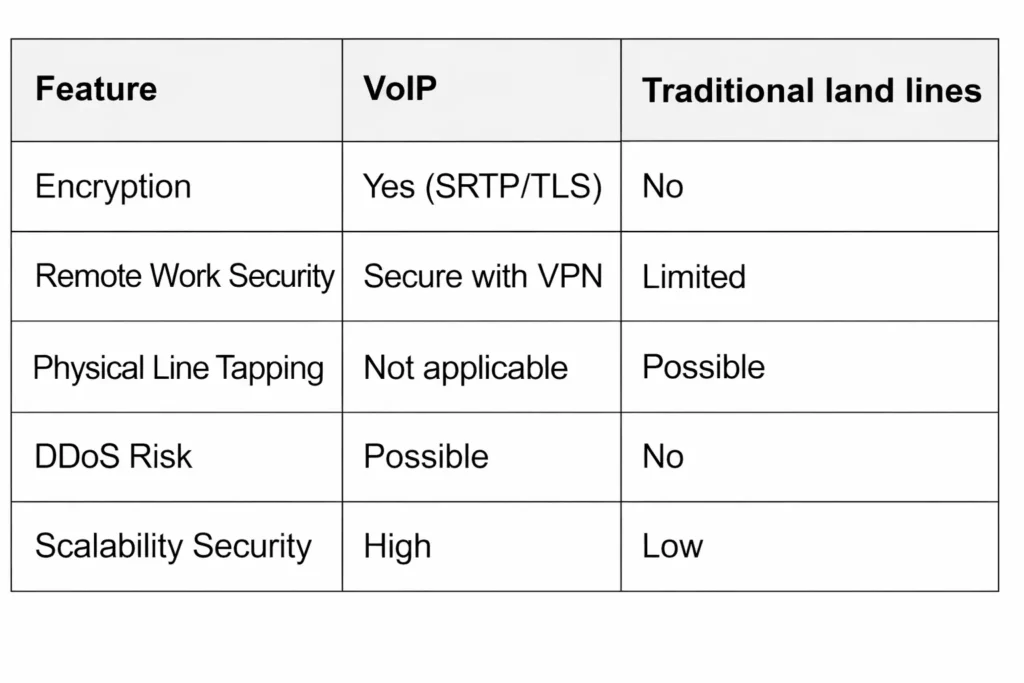
Traditional landlines avoid DDoS attacks but lack encryption and remain vulnerable to physical tapping. Ultimately, your configuration determines how secure is VoIP for business use. A properly secured cloud system offers protection and oversight that analogue lines simply cannot match.
Security Best Practices for Small Businesses
Canadian businesses should take practical steps:
- Use strong, unique passwords
- Enable MFA on all accounts
- Configure firewall rules specifically for VoIP
- Keep routers and firmware updated
- Require VPN access for remote employees
- Provide regular cybersecurity awareness training
- Conduct periodic security audits
Security is ongoing. It requires policy, discipline and the right infrastructure.
Compliance & Regulatory Considerations in Canada
PIPEDA
The Personal Information Protection and Electronic Documents Act (PIPEDA) sets the federal standard. However, businesses in British Columbia must also comply with PIPA. If your VoIP system records calls containing Personally Identifiable Information (PII), you are legally required to implement robust safeguards.
Industry-Specific Compliance
Healthcare providers are governed by strict provincial privacy acts, while financial services firms must meet rigorous record retention and data protection standards. In these high-stakes sectors, secure storage and controlled access to call recordings are non-negotiable requirements.
Data Storage & Cloud Responsibilities
Security is a partnership. The shared responsibility model defines this clearly: your provider secures the infrastructure, while your business manages internal policies. Canadian organizations prioritize domestic data residency. Local data centres keep your communications within Canadian borders, ensuring they remain under Canadian jurisdiction and protected from foreign access laws.
How to Choose a Secure VoIP Provider
Security is foundational to any vendor evaluation. When assessing providers, ensure they offer:
- Advanced Encryption: End-to-end protection using SRTP and TLS.
- Local Infrastructure: Secure Canadian data centres for residency compliance.
- Proactive Defence: Built-in DDoS mitigation and 24/7 monitoring.
- Regulatory Alignment: Full compliance with Canadian privacy requirements.
If you are searching for a reliable VoIP phone service or exploring a dependable business phone service in Coquitlam, prioritize providers who are transparent about their security architecture and compliance readiness.
Frequently Asked Questions
1. Is VoIP more secure than a landline?
Properly configured VoIP offers advanced encryption and access controls that legacy analogue lines simply cannot match.
Can VoIP calls be hacked?
Unsecured systems may be vulnerable. However, implementing SRTP encryption, robust firewalls and MFA significantly reduces these risks.
How does VoIP encryption work?
Encryption converts voice packets into unreadable code during transmission. Only authorized devices can decode the audio, ensuring your conversations stay private.
Is VoIP safe for financial or healthcare businesses in Canada?
Yes. When implemented with strong encryption and PIPEDA-compliant safeguards, VoIP meets the rigorous standards required for these sectors.
Do small businesses need a firewall for VoIP?
Yes. A business-grade firewall is foundational for regulating traffic and protecting your network from external threats.
What is SRTP in VoIP security?
Secure Real-Time Transport Protocol (SRTP) encrypts voice data while in transit. It ensures that even if data packets are intercepted, the content remains scrambled.
How can I protect my VoIP system from DDoS attacks?
Choose a provider with built-in DDoS mitigation and network-level traffic filtering to identify and block malicious traffic before it reaches your system.
Conclusion: Is VoIP Secure?
Is VoIP secure for small businesses? Yes, when built on a foundation of expert configuration. Modern VoIP platforms utilize robust encryption, layered security controls and monitoring capabilities that align with Canadian regulatory standards.
True security stands on two pillars: a dedicated provider and disciplined internal practices. If you haven’t audited your communications recently, now is the time. Reach out to eazyconnect today for a cost-effective and reliable business phone services customized to your team’s security needs. Let’s build a system that supports your growth, without compromise.
