

Across Canada, the shift away from traditional landlines is accelerating as businesses move toward more cloud-based solutions. Legacy systems were simply never designed for the level of disruption we face today. From ice storms in Ontario and flooding in British Columbia to wildfire evacuations in Alberta, local events can quickly escalate into operational crises. In this environment, maintaining operations is essential. When phone systems fail, sales slow, customer service is disrupted and brand reputation suffers. For small and mid-sized businesses, even a few hours of downtime can mean lost revenue and long-term customer impact. VoIP for business continuity represents a strategic move toward resilience. It strengthens your organization’s ability to stay connected, remain responsive and operate without interruption during unexpected events.
What Is Business Continuity?
Business continuity is the ability of an organization to maintain essential operations during and after a disruption. It ensures that mission-critical functions, especially communication systems, continue running despite power outages, cyber incidents or physical damage. Reliable telecom infrastructure is central to continuity planning.
Business Continuity vs Disaster Recovery
Business continuity keeps your doors open during a crisis. Disaster recovery restores your systems after a failure. A reliable phone system plays a critical role in supporting both.
Modern VoIP drives proactive continuity. Its cloud redundancy prevents downtime before it starts and shows how VoIP supports business continuity in real-world scenarios. VoIP also accelerates recovery by instantly rerouting calls to alternate devices or locations. This ensures your team maintains a professional presence, even when your physical office remains inaccessible.
Why Small Businesses Are Especially Vulnerable
Smaller organizations often operate with limited IT resources and single-location infrastructure. An on-site PBX creates a single point of failure; if that office loses power, the business loses its voice. For service-based companies, missed calls translate directly to missed revenue. This risk is immediate and measurable, but with a strategic cloud framework, it is also entirely preventable.
Common Disruptions That Affect Small Businesses in Canada
Canadian businesses navigate a unique range of disruptions:
- Grid Failures: Power outages affecting both urban and rural hubs.
- Connectivity Gaps: Unforeseen internet service interruptions.
- Environmental Hazards: Wildfires, snowstorms and regional flooding.
- Security Threats: Sophisticated cyberattacks and ransomware.
- Site Access Issues: Office closures from building damage or health restrictions.
- Hardware Risk: Critical failures in aging, on-site PBX systems.
A robust business continuity phone system must handle these scenarios seamlessly, ensuring your customer communication remains uninterrupted.
How VoIP Supports Business Continuity
Effective continuity planning begins with communication. Here is how VoIP strengthens your operational stability:
Cloud-Based Infrastructure
Modern VoIP platforms are hosted through cloud computing environments. This eliminates reliance on physical hardware in a single office. Updates are managed centrally and infrastructure is distributed across secure data centres. This foundation is what makes VoIP for Business Continuity a scalable and practical solution for Canadian businesses.
Remote Call Routing & Failover
If a primary internet connection fails, calls can automatically reroute to mobile devices or alternate locations. Advanced SIP trunking redundancy allows seamless failover without customers noticing disruption.
Mobile Device & App Integration
Softphone applications allow your employees to answer business calls from any smartphone or laptop. This enables hybrid teams and ensures your communication continues, even if physical offices must close.
Auto-Attendant & Call Forwarding
Automated menus maintain your professional presence, even during local outages. You can deploy emergency messaging instantly to direct customers to alternate contact methods. Smart call forwarding guarantees that no inquiry goes unanswered.
Voicemail-to-Email & Unified Messaging
The system delivers voicemails directly to your email inbox, preventing missed messages during a crisis. Unified platforms centralize your voice, messaging and collaboration tools into one resilient interface.
Number Portability & Geographic Flexibility
Your business retains its established numbers during any relocation or expansion. Virtual numbers across provinces support your growth without forcing you to depend on physical infrastructure.
VoIP vs Traditional Phone Systems During Emergencies
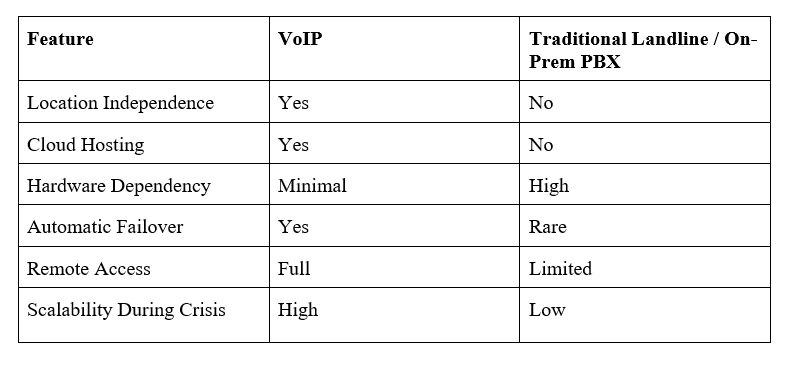
On-premises systems rely on physical hardware that fails or becomes inaccessible during a crisis. Traditional landlines depend on physical cables that storms or local construction can easily damage. When these systems go down, restoration often moves slowly, leaving your business disconnected when you need it most.
Limitations of On-Premise Systems
On-premises PBX systems rely on physical hardware located inside your office. Power outages, equipment failure or environmental damage can immediately sever your communications.
These systems create a single point of failure with no geographic redundancy. Recovery often demands manual repairs and on-site vendor support, delays that slow your response time during a critical crisis.
Landline Dependency Risks
Traditional landlines depend on copper wiring that is vulnerable to the elements and local construction. With our unpredictable Canadian weather, these risks are a constant reality. You cannot easily reroute calls to remote teams, which directly threatens your service continuity.
Key VoIP Features That Enable Business Resilience
A robust VoIP solution includes:
- Redundant, geographically distributed data centres
- Failover routing and uptime guarantees
- Backup SIP trunking connections
- CRM integration with tools such as Salesforce
- Secure remote access via VPN
These capabilities illustrate how VoIP supports business continuity through redundancy, flexibility and centralized control.
VoIP for Remote & Hybrid Teams
Remote and hybrid work models are now standard across Canada. VoIP enables your team through:
- Work-from-anywhere connectivity
- Virtual extensions and dedicated direct numbers
- Seamless call management via professional mobile apps
- Uninterrupted continuity during office closures
By adopting a cloud-based system, you reduce dependency on a physical office while delivering a consistent and professional customer experience.
Data Security & Compliance Considerations in Canada
PIPEDA and Data Protection
The Personal Information Protection and Electronic Documents Act (PIPEDA) mandates that you safeguard sensitive data, including call recordings. Encrypted voice traffic and controlled access help maintain compliance.
Secure Cloud Infrastructure
Modern VoIP systems use encrypted voice transmission, strong authentication controls, and certified data centre environments.
Shared Responsibility Model
Security is a partnership. While your provider secures the core infrastructure, your business manages endpoints and user access. Clear internal policies and regular audits remain the final, critical steps in a robust security strategy.
Business Continuity Planning Checklist for Small Businesses
A continuity plan should be structured and practical.
Actionable Checklist
- Audit vulnerabilities: Identify single points of failure in your current phone system.
- Verify Uptime SLAs: Confirm your provider guarantees 99.9% (or higher) uptime.
- Configure Auto-Failover: Ensure calls reroute instantly during a primary link failure.
- Deploy Mobile Access: Enable softphone apps for all essential personnel.
- Secure Redundant Connectivity: Maintain a secondary internet source (e.g., LTE/5G backup).
- Harden Remote Access: Implement secure VPNs or encrypted cloud entry points.
- Formalize Protocols: Create a clear emergency communication script for your team.
- Test Quarterly: Conduct live drills to ensure the plan works when you need it.
Proactive assessment eliminates downtime before a disruption starts.
Frequently Asked Questions
How does VoIP help during a power outage?
- Calls can reroute to mobile devices or alternate sites if local hardware is affected.
Can VoIP work if my office is closed?
Yes. Employees can access calls through secure mobile or desktop applications.
What happens if my internet goes down?
Failover routing can redirect calls to predefined devices or secondary connections.
Is VoIP reliable for Canadian small businesses?
When properly configured with redundancy, it is highly reliable.
How does SIP trunking support business continuity?
It provides redundant call routing paths, minimizing service interruption.
Is VoIP secure under Canadian privacy laws?
With proper encryption and safeguards, it aligns with compliance requirements.
Conclusion: Make VoIP Part of Your Business Continuity Strategy
Communication is a core operational infrastructure. Without it, workflows break down and customer confidence erodes. VoIP for Business Continuity provides flexibility, scalability and operational stability beyond the capabilities of traditional systems. Rather than viewing VoIP as simply a phone upgrade, Canadian businesses should see it as proactive risk management. It supports hybrid teams, protects customer experience and maintains operational stability during disruption.
If you haven’t evaluated the operational stability of your current VoIP phone service or explored upgrading to a dependable business phone service in Port Moody, now is the time to act. Don’t wait for disruptions to impact your operations. Connect with eazyconnects today to discover the best VoIP solutions for small businesses and homes, and let’s build a reliable communication system designed to keep your business running without interruption. Contact us now to get started.
